- Why Municipalities Are Building Their Own Fiber
- How Municipal Projects Differ from Private ISP Builds
- The Permitting Reality Nobody Tells You About
- GIS Deliverable Standards for City Asset Management
- Common Design Mistakes on Municipal Builds
- Phased Builds, BEAD Timelines, and Choosing the Right Partner
Cities don't move like private ISPs. They can't. There are council approvals, procurement rules, public records requirements, internal department politics, and — increasingly — federal grant timelines that add layers of complexity to every decision. I've been doing this for 30 years, and municipal engagements are consistently the most technically rewarding and the most institutionally demanding work we do.
More cities are finally building. BEAD funding, digital equity mandates, and competitive pressure from private carriers who've ignored certain neighborhoods for decades — all of it is pushing municipalities toward fiber ownership. A mid-size city in rural Michigan recently completed a $4.7M HLD scope for a 28-mile backbone serving six underserved districts. A county seat in western Virginia is halfway through a 14-month procurement cycle for a BEAD-funded last-mile deployment covering 3,200 addresses. Both started by getting the engineering right.
This article covers what I tell every municipality that reaches out to us. The OSP engineering services side of a city build isn't just about drawing fiber routes. It's about understanding how public-sector constraints shape every design decision, and making sure your engineering partner knows that going in.
Why Municipalities Are Building Their Own Fiber
Three forces are driving this shift, and they're converging at the same time.
First: BEAD. The Broadband Equity, Access, and Deployment program lets municipalities apply as subgrantees through their state broadband office. Some states are actively pushing cities to participate. If you're navigating this, the BEAD engineering requirements are more specific than most cities expect. You can't submit a route map and a cost estimate. States want HLD documentation, GIS deliverables in specified formats, phased timelines, and engineering sign-off at each milestone.
Second: digital equity mandates. The infrastructure law made it harder for cities to ignore unserved pockets within their own boundaries. When a council is looking at a map showing 18% of residential addresses in the eastern ward have no broadband — and federal funding is available — inaction has a political cost it didn't have five years ago.
Third: competitive pressure. Some cities watched a private ISP spend a decade promising fiber that never materialized. They got tired of waiting. For a municipality that already owns 312 miles of conduit installed alongside water and sewer lines over the past 40 years, the economics of a city-owned build look very different than a greenfield private build.
How Municipal Projects Differ from Private ISP Builds
Municipal broadband engineering isn't technically harder than private ISP work. The difficulty is institutional — and firms without public-sector experience routinely underestimate it.
| Dimension | Municipal Build | Private ISP Build |
|---|---|---|
| Procurement | Formal RFP process, public bid, board or council approval; 3–6 month cycle minimum | Direct negotiation, can execute in weeks |
| Decision authority | Distributed across 23+ city departments: public works, IT, utilities, legal, finance, city council | Concentrated in project manager or VP of network |
| Wage requirements | Prevailing wage typically required for federally funded work; Davis-Bacon compliance | Market rate, no federal wage floor requirements |
| Records exposure | All project documents subject to FOIA/public records requests | Fully confidential |
| Design approval cycles | Multiple internal reviews; council sign-off required before construction authorization | Internal engineering review only |
| BEAD documentation | Required at HLD and LLD stages; state broadband office review gates | Not applicable unless acting as BEAD subgrantee |
The HLD design for BEAD subgrantees has specific documentation requirements that don't exist in a standard private ISP engagement. A municipality acting as a subgrantee needs to demonstrate in its HLD that the proposed design will achieve coverage targets in its grant application — with GIS deliverables mapping directly to awarded locations. That requires the engineering firm to understand the grant structure and work backward from coverage commitments.
A 14-month procurement cycle means HLD work completed in month 3 may not be acted on until month 15. Cost assumptions shift. In some cases the HLD needs to be refreshed before LLD begins. An engineering firm that doesn't build this into its project plan will leave you with stale documents and a scope dispute when you finally get to construction authorization.
The Permitting Reality Nobody Tells You About
Here's what surprises most cities: permitting within your own ROW is still complicated.
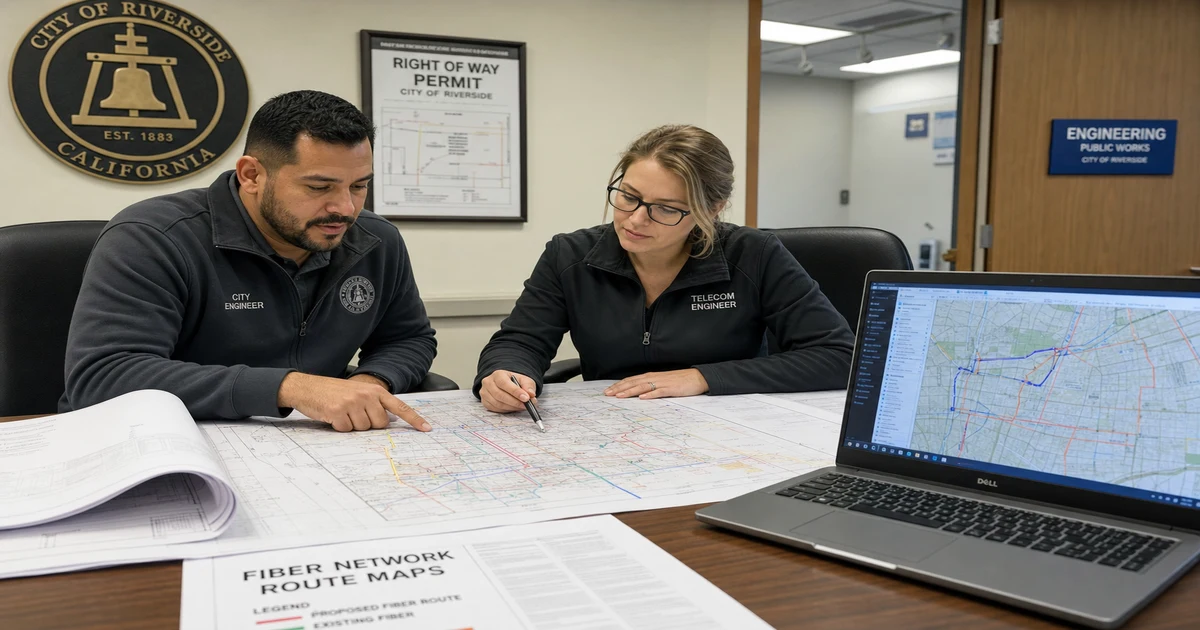
You'd think a city building fiber along its own streets would have a streamlined path. In theory, yes. In practice, permitting coordination happens between departments that don't necessarily talk to each other — public works, the utility department, the telecom office if one exists, and sometimes the state DOT if the route crosses state-maintained roads. We've been on projects where public works didn't know the telecom team had already run conduit under a particular intersection. The conflict only surfaced during LLD when we started pulling utility records.
The permitting timeline for a municipal build needs to account for internal coordination that's often slower than external permitting. Getting sign-off from 23 city departments on a route that crosses utility corridors, parks, and school property can take longer than getting a state DOT permit. It's not bureaucratic malice — it's just how distributed municipal decision-making works. Your engineering firm needs to know this and plan for it.
Real-world note: On a 19-mile underground build for a mid-Atlantic city, we identified a 4-block conflict zone where the city's water department had undocumented conduit installed in the 1990s — not in any GIS record, not in any permit history. The only reason we caught it before construction was a routine utility conflict check that included a direct call to the water department's field crew, not just a records pull. That's what public-sector OSP engineering looks like when it's done right. You don't assume the records are complete. They aren't.
The permit drawings for a municipal fiber build need to meet the standards of multiple reviewing departments simultaneously. Public works wants to see road cut dimensions and pavement restoration specs. The utility department wants clearance documentation relative to existing gas, water, and electric infrastructure. The telecom office — if the city has one — wants GIS-ready outputs that can feed into the asset management system. A plan set that satisfies one department and not the others will cycle through revisions until it satisfies all of them. That revision cycle costs time, and in a BEAD-funded project, time has a direct cost in grant milestone compliance.
GIS Deliverable Standards for City Asset Management
Cities have GIS systems. Most of them are messy, underfunded, and managed by an IT department that's already stretched thin. That's the reality you're building into.
When a municipality commissions OSP engineering, the GIS deliverables need to match what the city's asset management system can actually ingest — not what the engineering firm normally produces. This sounds obvious. It isn't. I've seen situations where a city received a full set of GIS deliverables in GeoPackage format and their IT department spent three weeks figuring out why their 2017-era ArcGIS Desktop installation wouldn't open them. The project wasn't wrong. The format mismatch was a communication failure that happened because nobody asked the right questions at project kickoff.
Here's what the conversation needs to cover before design starts:
- What GIS platform does the city run? Esri ArcGIS, QGIS, Cityworks, Maximo — the answer determines acceptable import formats. Most city environments are Esri-based, so File Geodatabase (.gdb) or Shapefile are the safe defaults.
- What coordinate reference system does the existing infrastructure database use? Delivering new fiber records in NAD83 when the city's water system records are in a local state plane system means a manual projection transformation before any records can coexist. That introduces errors.
- What attributes does the asset management system require per feature class? A city maintaining fiber records in Cityworks needs specific fields populated — installation date, material, condition — or the import fails. The engineering firm needs to know this before the schema is designed.
- CAD vs. GIS format wars inside city IT. Some public works departments work exclusively in AutoCAD. The telecom team wants GIS. IT wants something it can manage. The best approach: deliver both, document the relationship between the CAD plan set and the GIS data, and let the city sort out its internal governance.
Common Design Mistakes on Municipal Builds
The mistakes I see on municipal builds fall into a few consistent patterns — and they're different from the mistakes on private ISP builds.
Over-engineered backbone, under-designed last-mile. A city gets excited about the backbone — the 10-mile ring connecting city facilities, the library system, the community centers. They treat last-mile as something to figure out later. Then "later" arrives and the last-mile design is rushed and doesn't account for the distribution architecture needed to serve residential addresses. The backbone sits idle for 18 months while last-mile catches up. Don't let this happen. Design both together, or at minimum define the downstream architecture before the backbone design is finalized.
Failing to account for underground conflicts on city-maintained streets. City streets are full of undocumented infrastructure — abandoned water lines, old telecom duct banks, gas mains rerouted and never updated in the GIS. A fiber design that skips a thorough utility conflict analysis will encounter those conflicts during construction. Bore a conflict zone in the wrong place and you're looking at a redesign, permit revision, and construction standdown that costs more than the original engineering engagement.
Treating BEAD timelines like private-sector timelines. They aren't. BEAD subgrant administration has milestone reporting requirements and state review gates that don't exist in a private ISP build. The HLD has to be complete and approved before state reviewers will authorize LLD; the LLD has to meet specific documentation standards before construction authorization. A firm delivering on private-sector speed in a BEAD-funded public project will miss gates and potentially jeopardize the grant.
Underestimating the council approval cycle. Council approvals can pause a project 60 to 90 days between phases. That's not a knock on public accountability — it's just reality. If your engineering firm isn't building those pauses into the schedule, you'll be paying for idle resources or rushing to finish LLD before a meeting that gets postponed anyway.
Phased Builds, BEAD Timelines, and Choosing the Right Partner
Most municipalities can't build it all at once. Budget constraints, crew availability, and political realities all push toward a phased approach. That's fine — as long as the phasing is engineered into the design, not bolted on later.
The right sequence: HLD for the full network, then LLD by district, then construction by district. The HLD gives you the architecture — backbone routes, distribution hubs, how last-mile segments connect to the core. It also tells you which districts build easiest and which ones need special permitting. You don't want to discover that District 4 has a 6-month state DOT permitting process after committing to a construction start based on District 1's timeline.
Phasing by district makes BEAD reporting manageable. Close out each district as a discrete milestone, document the as-built records, and submit to your state broadband office before moving to the next phase. That's cleaner than managing a whole-network as-built at project completion — especially when construction runs across multiple contractor teams at once.
What should you ask an OSP engineering firm before you sign?
- Do you have references from public-sector clients? Not ISPs. Cities, counties, or public utilities that went through a procurement cycle, a council approval process, and a BEAD milestone review. Ask for contacts, not logos.
- What's your experience with city procurement timelines? Specifically: have they worked where the procurement cycle ran longer than 6 months, and how did they handle scope and cost management during that wait?
- What CAD deliverable formats does your public works department accept? Answer this before you ask the firm — but the firm should be asking you the same question. If they're not asking, that's a signal.
- Can the firm meet your state's BEAD documentation requirements? Each state broadband office has its own GIS and reporting standards. An engineering firm new to your state may not know what those are. Find out early.
The process for choosing an OSP engineering partner for a municipal project differs from choosing one for a private ISP build. Technical skills overlap; institutional knowledge doesn't. You want a firm that has been through a public procurement cycle, understands prevailing wage compliance, and has navigated the multi-department coordination that defines every municipal fiber project.
Draftech has delivered OSP engineering services for city and county clients across 22 states. We're MBE certified — which matters for municipalities with diversity procurement goals and for BEAD grant reporting that includes equity benchmarks. We're available across all 50 U.S. states and have worked through the full range of public-sector complexity: 14-month procurement cycles, multi-department permitting coordination, BEAD milestone documentation, and phased builds where Phase 1 construction overlaps with Phase 2 LLD. If your city is planning a fiber build — or is mid-process and running into the problems I've described — reach out at info@draftech.com.