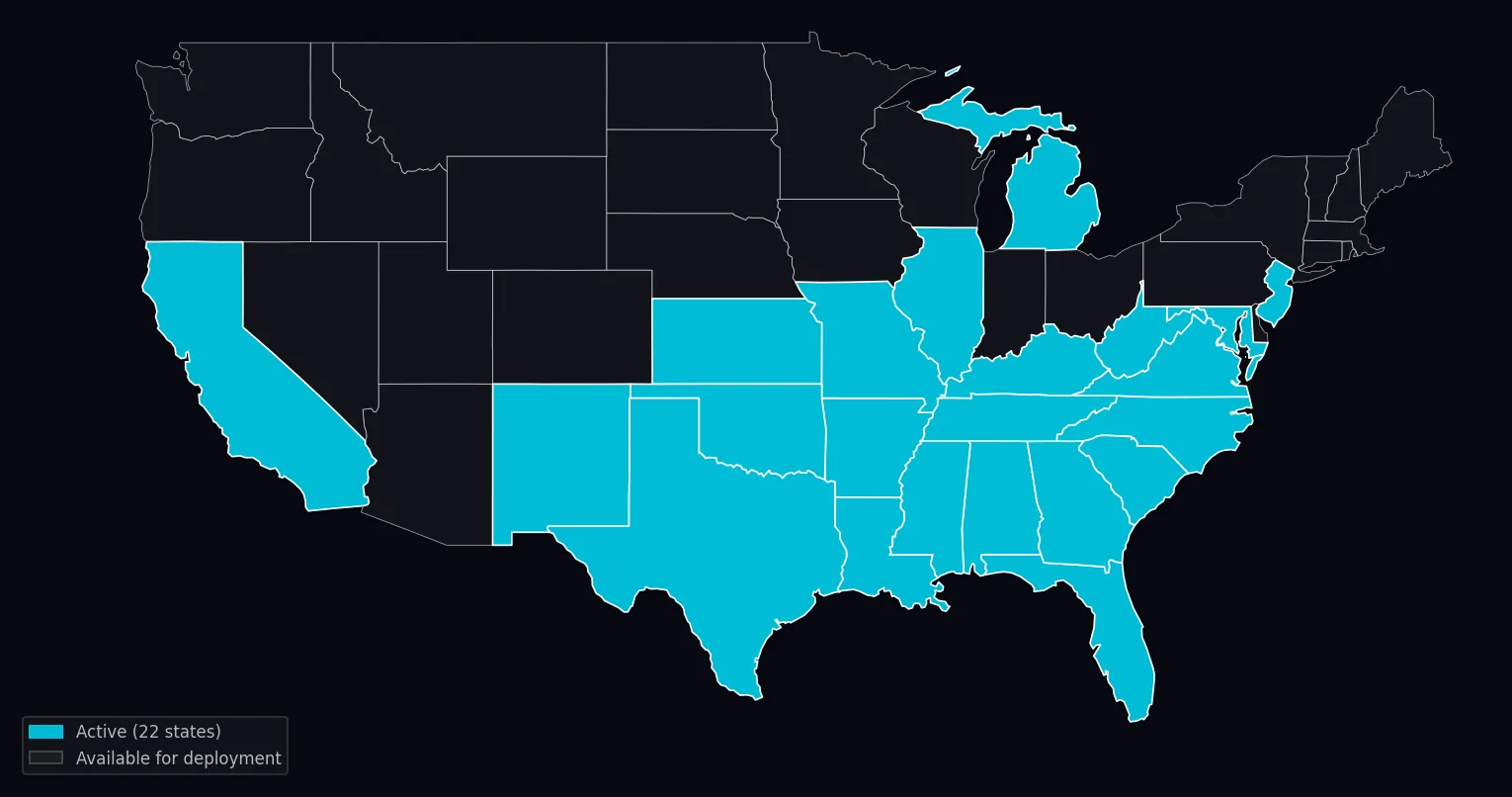
Hover any state to see its BEAD broadband allocation. Draftech delivers OSP engineering, FTTH design, pole loading, and grant documentation across every state in the country — active in 22 and deployable everywhere.
The Broadband Equity, Access, and Deployment (BEAD) program allocated $42.45 billion through the NTIA to bring high-speed internet to unserved and underserved communities across all 50 U.S. states. Each state operates its own program office, sets its own subgrantee requirements, and manages its own challenge process — meaning the engineering documentation required in Texas differs from what's expected in Maine or West Virginia. Draftech engineers understand these differences at a state-by-state level.
State broadband offices require ISP subgrantees to submit engineering documentation as part of their initial proposal. This typically includes a High-Level Design (HLD) showing proposed fiber routes, coverage maps, technology type (FTTH, fixed wireless, hybrid), and estimated cost per location passed. Draftech produces BEAD-ready HLD packages aligned to each state's specific template requirements.
ROW permitting requirements vary significantly by state. States like Florida (FDOT) and Texas (TxDOT) have established fiber-specific permit frameworks, while rural states may require county-level road authority permits for every road crossing. States with significant tribal land — like New Mexico, Oklahoma, and Montana — require separate tribal permitting processes that add weeks to project timelines if not anticipated in early planning.
BEAD grant closeout requires as-built documentation that shows constructed fiber routes verified against the original design. Most state broadband offices require GIS shapefiles with feature attributes including fiber strand count, conduit type, splice point locations, and FDH placement. Draftech produces as-built packages formatted specifically for each state's broadband office submission portal and long-term network records.
OSP design decisions change based on state terrain. Mountainous states like West Virginia and Kentucky require detailed aerial span analysis and underground bore planning through rock. Coastal states like Florida and Louisiana add considerations for hurricane hardening and saltwater corrosion on aerial infrastructure. Midwest states often have extensive agricultural drainage systems that complicate directional boring routes. Draftech field teams are trained for these regional variables.
Browse the state guides below to see BEAD funding allocations, permitting authorities, and available Draftech services for each state.
Request a State Proposal Read Our BEAD Engineering BlogClick any state to open the full engineering guide. Hover to see BEAD allocation, active services, and deployment status.
No vendors to coordinate. No handoffs between firms. One team handles every phase from HLD through as-built documentation, in any state.
Every state page covers BEAD program status, terrain, utilities, permitting authorities, and available Draftech services.
Whether you're a rural ISP navigating BEAD documentation or a large carrier scaling aerial construction, Draftech has the team and the track record to deliver.
BEAD allocations vary by state based on the number of unserved and underserved locations identified in the FCC broadband map challenge process. The largest allocations went to Texas ($3.31B), California ($1.86B), and Michigan ($1.56B). Smaller states like Delaware and Rhode Island received allocations under $100 million. Each state page on this site shows the specific BEAD allocation and active Draftech services for that state.
Yes. Draftech is currently active in 22 states and available to deploy engineering teams across all 50 U.S. states. New state deployments typically begin with a project scoping engagement where we review grant documentation requirements, permitting jurisdiction, and existing infrastructure data before committing to a project timeline. Contact us at info@draftech.com or call 305-306-7407 to discuss a new state deployment.
Draftech works with rural electric cooperatives, independent ISPs, cable operators expanding into fiber, and large-scale prime contractors managing multi-state BEAD deployments. We also support tribal internet service providers navigating the intersection of BEAD grants and tribal utility permitting. Our team is experienced with projects ranging from small rural builds of a few hundred locations to large county-wide deployments covering tens of thousands of homes passed.
BEAD engineering timelines depend on project scale, terrain, and state-specific permitting complexity. A High-Level Design package for a rural county project typically takes four to eight weeks from field survey completion. As-built documentation follows construction and typically requires six to ten weeks for a standard rural project, including GIS processing and quality review. Projects in states with complex permitting — such as those with significant rail crossings or tribal jurisdiction — may require additional time for permit coordination.
Yes. GIS deliverables are a core part of every Draftech engineering engagement. We produce feature-attributed network shapefiles and geodatabases with the field schema required by each state's broadband office — typically including fiber count, conduit material, route type (aerial or underground), splice point coordinates, FDH locations, and coverage polygon layers. Deliverables are reviewed internally before submission to ensure they pass state broadband office validation checks without revision requests.