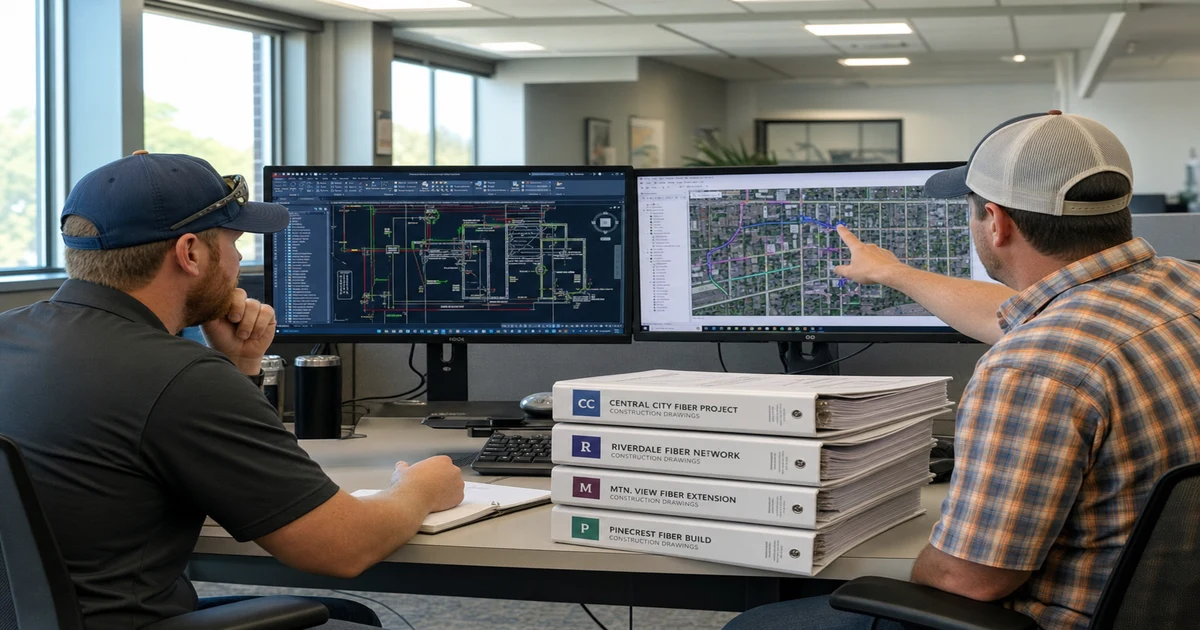
I get a version of the same call about once a week. An EPC firm just won a fiber contract — sometimes a BEAD award, sometimes a rural broadband expansion, sometimes a state-funded middle mile project. They're excited. Then reality sets in: they don't have the engineering headcount to actually design the routes they just contracted to build.
That's the call that leads to a white-label OSP design engagement. Not a referral, not a marketing pitch — a contractor who's three weeks into a project realization that their in-house team can't handle the volume. I've been in fiber network engineering for 17 years, and I've watched this gap grow wider every single year as broadband funding programs outpace the available pool of experienced OSP designers.
This article explains exactly how white-label OSP design works, who uses it, what's included, and how to evaluate a firm you're considering. No fluff. Just the information you need to decide whether this model fits your situation.
What White-Label OSP Design Actually Means
White-label OSP design is straightforward. Your firm contracts with us. We do the engineering. You put your name on it.
The end client — whether that's a municipality, a rural electric cooperative, a WISP, or a state broadband office — sees your company's logo on every deliverable. Your title block, your cover sheet, your project number format. Draftech's name doesn't appear unless you want it to. We're the engineering team behind the curtain, and you maintain the client relationship from kickoff through project closeout.
It's not a novel arrangement. Construction firms subcontract specialty work constantly — electrical, structural, environmental. White-label OSP engineering services follows the same model, applied to fiber route design. The difference is that the deliverables look identical to work produced by an internal engineering team, because the same quality standards apply regardless of whose name is on the cover.
What it's not is a resale of template documents. Every engagement involves actual route engineering — field data intake, design decisions, permit package preparation, GIS exports — performed by engineers who've done this on hundreds of fiber projects across 22 active states. The white-label wrapper is a branding arrangement, not a shortcut on the technical work.
Who Actually Uses White-Label OSP Services
Four types of firms call us regularly for white-label work.
EPC firms that won fiber contracts without an in-house engineering team. This is the most common scenario right now, driven almost entirely by BEAD and related funding programs. A firm that's been doing utility construction for 20 years wins a BEAD award for a rural county network. They can manage the construction side. They can't staff 47 LLD sheets per 10 miles of route on a 90-day timeline — not without hiring engineers they don't have relationships with and won't need after the project wraps.
Civil and construction firms entering telecom for the first time. A civil firm in rural Mississippi that built roads and bridges for years sees broadband funding as a natural adjacent market. They know how to manage permits, right-of-way, and construction crews. OSP fiber design? That's a different discipline with different tools, different standards, and a very specific talent pool. White-label lets them enter the market without building an engineering practice from scratch.
ISPs that outgrew their internal design capacity. An ISP with 3 or 4 internal designers gets a $3.4M BEAD engineering contract and suddenly needs the output of 10 designers for 18 months. Hiring that fast isn't realistic. White-label handles the overflow while the client's team manages project coordination and client communication.
General contractors expanding into broadband. GCs who've built cell towers, data centers, and utility infrastructure are getting pulled into fiber builds by their existing clients. They need engineering deliverables that meet carrier and state broadband office standards — fast. Their general construction credentials don't automatically translate to OSP design capability, and they know it.
Why Firms White-Label Instead of Hiring
The fiber engineering talent market is brutal right now. That's not an opinion — it's what every project manager in this industry is dealing with.
An experienced OSP designer with LLD proficiency, GIS fluency, and permit package experience runs $95k–$130k per year in base salary. Add benefits, payroll taxes, equipment, software licenses, and the actual loaded cost is $112k or higher for a single mid-level engineer. That assumes you can find one. Experienced OSP designers aren't sitting on job boards — they're already employed, often on multi-year contracts tied to large BEAD awards or carrier network builds.
There's also the timeline problem. A firm that wins a BEAD contract in April doesn't have three months to run a recruiting process, extend an offer, wait out a notice period, and onboard a new hire before route design needs to start. The program timeline doesn't wait. White-label OSP engineering outsourcing deploys in days, not months.
And then there's the project-specific demand curve. Most of the firms that call me don't need a full-time engineering team permanently — they need engineering capacity for one, two, or three projects over 18 to 36 months. Hiring for that demand spike means laying people off when the work is done. That's a bad outcome for everyone, and most firms know it going in.
Real scenario: An EPC contractor in Ohio won three BEAD awards simultaneously — different counties, different program timelines, different permit jurisdictions. Combined route scope was roughly 340 miles. Their internal team had two OSP engineers. They needed the output of eight. We stood up a white-label engagement within 7 business days of contract signing, staffed 6 designers to their project queue, and delivered the first permit package 19 days after data intake. They presented every deliverable under their company name. Their client never knew we were involved. That's the model working as intended.
What a White-Label Engagement Includes
The scope of a white-label OSP engagement depends on what the prime contractor needs, but most engagements cover some combination of the following deliverable categories.
High-Level Design (HLD). Route alignment, technology selection, splice point placement strategy, node and headend locations, fiber count selection. HLD planning produces the planning-level documents that define the network architecture before detailed engineering begins — and it's what state broadband offices typically review in initial BEAD submissions. We can produce HLD packages branded entirely in the client's template.
Low-Level Design (LLD). The full engineering package — plan sheets, pole schedules, make-ready summaries, splice diagrams, detail sheets, fiber assignment tables. For a 10-mile aerial route, expect roughly 47 LLD sheets in a complete package. Underground routes in denser corridors can run higher. LLD is what the construction crew actually builds from, and it's what permit reviewers check against NESC and local right-of-way standards.
Permit packages. Every permit jurisdiction has its own requirements for what needs to be in a submission — sheet format, coordinate reference system, title block fields, required details. We handle permit prep for VDOT, TXDOT, ALDOT, utility make-ready filings, municipal ROW permits, and railroad crossing agreements. This is where errors are most expensive, and it's where our QC process is most disciplined.
GIS deliverables. Shapefiles, GeoJSON, ESRI File Geodatabase exports with proper attribute schemas. Network planners and state broadband offices increasingly require GIS-ready data alongside PDF plan sets. Check the construction package deliverables guide for a breakdown of what each deliverable category contains and what downstream uses it supports.
As-builts. Revised drawings reflecting what was actually constructed, incorporating field markup. As-builts are often required by the funding program and are the baseline record for future network maintenance and expansion.
All of the above can be delivered on the client firm's template. Title block, logo, project numbering, sheet border format — we match it. If the client doesn't have a standard template, we use a clean, professional format with their branding applied. The end client receives a polished package that looks like it came from the prime contractor's engineering team. That's the point.
How the Workflow and Quality Control Works
The hand-off process matters as much as the technical work. A white-label engagement that produces good drawings but creates coordination chaos for the prime contractor isn't actually useful.
Our intake process starts with route data. GPS trace, aerial imagery reference, field survey notes, utility GIS exports, make-ready reports if they exist. We run a data quality check within 24 hours of receipt and flag any gaps before design starts — wrong pole IDs, missing survey data for specific spans, unclear permit jurisdiction boundaries. It's better to surface those issues at intake than to discover them mid-design.
Design review gates are built into the workflow. We don't send 200 sheets at once and ask for feedback. We route design in blocks — typically 10 to 20 sheets — with a review checkpoint before the next block starts. Client approval at each gate means we're not 60% through a package before discovering a routing decision that needs to be reconsidered.
Revision turnaround is a commitment, not a best-effort estimate. Error-correction revisions — meaning something in the drawings doesn't match the agreed design intent — are turned around within 3 business days. For scope-change revisions, we provide a quote within 4 hours of the change request.
On the quality control side: white-label work actually has to be better than a named engagement. That's counterintuitive to people who assume that if Draftech's name isn't on it, the standard must be lower. The opposite is true. When the prime contractor puts their name on our deliverables, any mistake in those drawings reflects on their firm, not ours. That creates a very direct incentive to run a tight QC process. Every package goes through a structured cross-reference check — pole IDs against utility GIS, clearance dimensions against NESC, bore crossing details against DOT requirements — before it leaves our team. When you're choosing an OSP engineering partner, ask specifically what their QC process looks like on white-label work. If there's no differentiation, that's a gap.
Pricing Models and How to Evaluate a White-Label OSP Firm
Three pricing structures are common in white-label OSP engagements, and the right one depends on how your project work actually flows.
Per-mile pricing works for project-based route design with a defined scope upfront. You know the route mileage, the deliverable set, and the timeline. Per-mile pricing gives you a clear project cost to build into your bid. The risk is that per-mile rates don't account for variation in route complexity — a mile of underground urban route takes considerably more design time than a mile of rural aerial on existing distribution poles. Make sure the per-mile rate is defined for a specific route type, not as a blanket number.
Per-deliverable or per-sheet pricing fits firms that need discrete packages at irregular intervals — an LLD package here, a permit submission there, an as-built update three months later. It's the most flexible structure and the easiest to track against project budgets. The downside is that it doesn't give you reserved engineering capacity — you're competing with other clients for scheduling when you need work done fast.
Retainer arrangements are the right model for EPC firms and GCs with steady project flow — typically 3 to 8 active routes at any point. A monthly retainer buys a defined block of engineering hours and guarantees scheduling priority. For firms doing $5M to $20M in annual fiber construction, a retainer usually makes more sense than per-project pricing, because the work is continuous enough that the administrative overhead of scoping each engagement individually starts to add up.
Understanding fiber network design cost across these models helps you build accurate bids. A firm that can't give you a clear cost structure for each model — or that quotes only per-mile without explaining what's included — deserves scrutiny before you sign anything.
What to Ask Before Signing a White-Label Agreement
References from similar engagements matter. Ask specifically for references from firms that used the provider for white-label work, not just project-based design. The confidentiality challenge is real — a good white-label provider may not be able to disclose client names without permission — but they should be able to provide references who can speak to the quality and workflow, even without naming the end client.
Sample packages tell you a lot. Ask for a redacted LLD package from a comparable route type. Look at the sheet organization, the title block discipline, the layer management in the DWG, the GIS attribute schema. A firm that can't produce a clean sample package probably can't produce a clean deliverable package for your client either.
Revision policy in writing. How many revision cycles are included? What's the turnaround commitment on error-correction revisions vs. scope-change revisions? Who determines which category a given revision falls into? If the contract doesn't answer these questions specifically, you'll answer them in a dispute later.
Subcontractor disclosure requirements. Some prime contractor agreements and BEAD program requirements include provisions about subcontractor disclosure. That's your obligation to manage, not the white-label provider's — but a good provider will flag it during contract review and make sure the white-label arrangement is structured in a way that doesn't create compliance problems for you.
IP ownership. The drawings are yours. That should be stated explicitly: upon payment, all deliverables become the property of the client firm, with no retained license by the engineering subcontractor. Don't sign an agreement that's ambiguous on this point. The end client may need to modify, redistribute, or use the drawings as the basis for future design work — restrictions on IP ownership create downstream problems.
Confidentiality provisions should run both directions. Draftech doesn't disclose client engagements. We don't use client route data, project details, or business relationships as portfolio examples without explicit written permission. That's not just a courtesy — it's how white-label arrangements have to work to be trustworthy over a long engagement.
The firms that do this well are the ones who call after their first white-label project and say they want to lock in a retainer. Not because the pricing is better — though it usually is — but because the workflow is predictable, the deliverables are consistent, and their clients have no idea how the engineering gets done. That's the outcome we're building toward on every engagement.
If you're evaluating whether white-label OSP engineering outsourcing fits your current project load, reach out at info@draftech.com. We'll tell you honestly whether it's the right model for your situation — and if it is, what a first engagement typically looks like from data intake to final deliverable.
In-House Hire vs. White-Label OSP: A Direct Comparison
| Factor | In-House Hire | White-Label OSP |
|---|---|---|
| Cost | $112k+ loaded salary per engineer, plus benefits, software, and equipment | Per-mile, per-deliverable, or retainer — scales with actual project volume |
| Speed to Deploy | 3–5 months from job post to first productive deliverable | 5–7 business days from agreement execution to active design |
| Scalability | Fixed; adding capacity requires another full hire cycle | Scales up or down with project pipeline — no hiring lag |
| Risk | Salary obligation continues whether project flow is steady or not | Engagement ends when the project does; no ongoing overhead |
| IP Ownership | Owned by employer | Owned by client firm upon payment, per agreement |
| Brand Visibility | Internal team — client sees your firm's work | All deliverables branded in client firm's name — end client sees no difference |
| Quality Control | Depends on internal processes and supervision | Structured QC gates built into workflow; error-correction revisions at no charge |